
Market Overview:
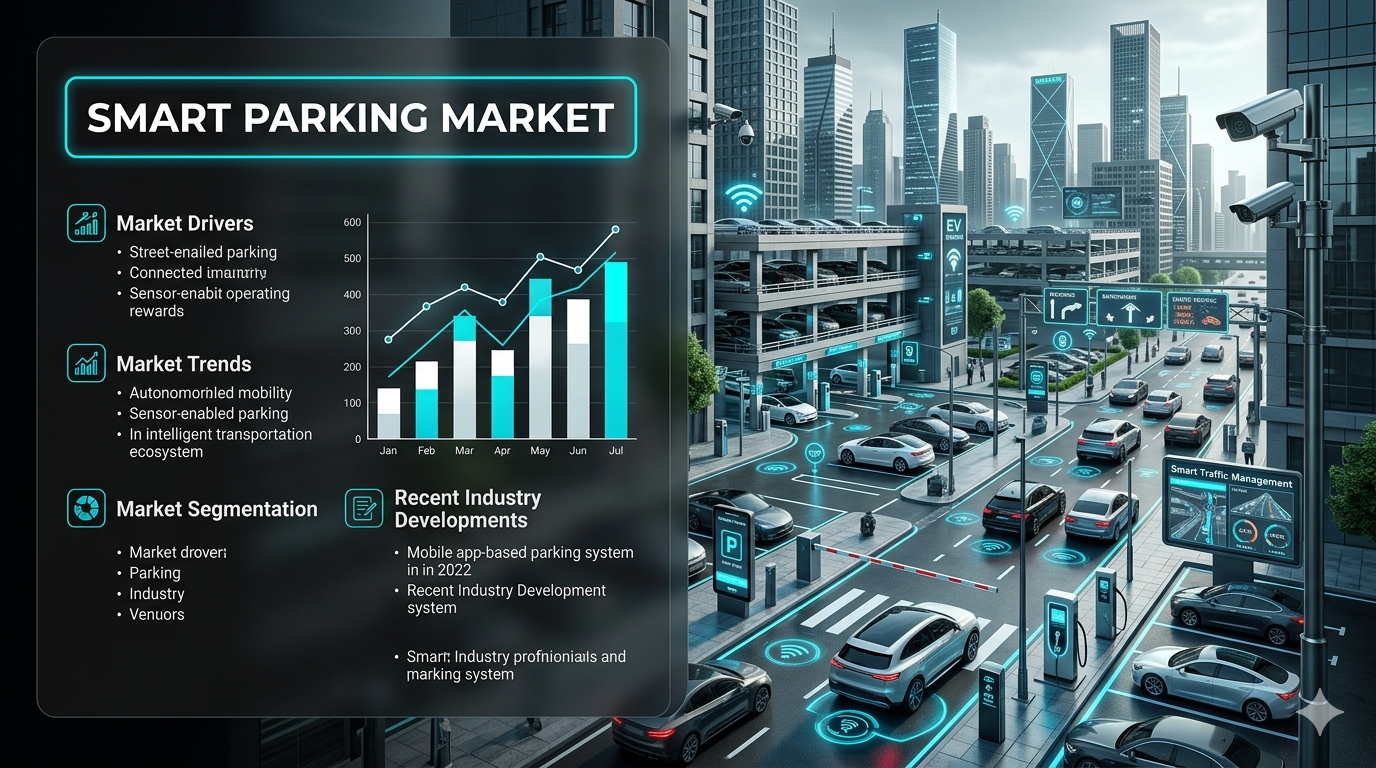
The smart parking market is experiencing rapid growth, driven by global expansion of smart city initiatives, escalating global vehicle ownership and urbanization, and integration of electric vehicle (EV) Charging Infrastructure. According to IMARC Group's latest research publication, "Smart Parking Market Size, Share, Trends and Forecast by System, Technology, Component, Solution, Vertical Type, Parking Site, and Region, 2026-2034”, the global smart parking market size was valued at USD 6.3 Billion in 2025. Looking forward, IMARC Group estimates the market to reach USD 15.8 Billion by 2034, exhibiting a CAGR of 10.10% during 2026-2034.
This detailed analysis primarily encompasses industry size, business trends, market share, key growth factors, and regional forecasts. The report offers a comprehensive overview and integrates research findings, market assessments, and data from different sources. It also includes pivotal market dynamics like drivers and challenges, while also highlighting growth opportunities, financial insights, technological improvements, emerging trends, and innovations. Besides this, the report provides regional market evaluation, along with a competitive landscape analysis.
Download a sample PDF of this report: https://www.imarcgroup.com/smart-parking-market/requestsample
Our report includes:
- Market Dynamics
- Market Trends and Market Outlook
- Competitive Analysis
- Industry Segmentation
- Strategic Recommendations
Growth Factors in the Smart Parking Market
- Global Expansion of Smart City Initiatives
Government-led urban modernization projects serve as a primary catalyst for the widespread adoption of smart parking infrastructure, significantly influencing the global smart parking market size 2025. In 2026, many metropolitan authorities are prioritizing digital traffic management to resolve chronic urban density issues, with Asia-Pacific cities witnessing a notable investment surge in IoT-based frameworks. For example, Europe currently commands a significant 35.8% share of the market, driven by stringent environmental regulations and sustainability goals that necessitate efficient vehicle idling reduction. National initiatives, such as those in Singapore and India, provide substantial funding for integrating smart sensors and centralized software into public transit hubs. These efforts aim to minimize the estimated 30% of urban traffic congestion caused solely by drivers searching for parking. By embedding these systems into the broader smart city landscape, governments are effectively creating a standardized digital ecosystem that supports long-term municipal mobility and reduces carbon footprints through improved traffic flow.
- Escalating Global Vehicle Ownership and Urbanization
The continuous rise in the global automotive fleet, combined with rapid urbanization, has created a critical imbalance between vehicle volume and available parking inventory. As more individuals migrate to urban centers, the demand for off-street parking solutions has intensified, with this segment capturing approximately 73.2% of the market share in 2026. Commercial institutions and corporate facilities are increasingly forced to adopt automated management systems to handle the high volume of daily commuters. To address this, companies like Smart Parking AG are expanding operations across Europe, including Switzerland and Germany, to provide the necessary hardware and software for private lot optimization. The necessity for advanced space utilization is further supported by data indicating that modern parking facilities must now accommodate larger vehicle dimensions and higher turnover rates. This demographic shift ensures that smart parking is no longer a luxury but a fundamental requirement for functional urban infrastructure.
- Integration of Electric Vehicle (EV) Charging Infrastructure
The transition toward sustainable transportation has turned parking lots into essential energy hubs, significantly fueling industry expansion. Market data in 2026 reveals that nearly 46% of recent smart parking investments are directed toward the integration of Electric Vehicle charging stations within existing parking management platforms. This dual-purpose utility allows operators to offer value-added services while optimizing revenue through multi-functional space usage. A prominent example is the GoParkin™ system in Singapore, which represents the first fully integrated platform combining parking, EV charging, and automated digital payments. By allowing users to locate, book, and charge their vehicles through a single mobile interface, companies are successfully tapping into the growing EV user base. This synergy between energy infrastructure and parking software encourages higher adoption rates among commercial developers who seek to future-proof their properties against the shifting requirements of the modern automotive market.
Key Trends in the Smart Parking Market
- AI-Powered Predictive Analytics and Demand Forecasting
Artificial Intelligence has shifted the industry from reactive monitoring to proactive, data-driven management. In 2026, operators are increasingly utilizing machine learning algorithms to analyze historical occupancy patterns and forecast future parking demand with high precision. This trend enables the implementation of dynamic pricing models, where parking rates adjust in real-time based on current availability and peak traffic hours. For instance, sensors and AI-driven computer vision systems now provide 24/7 data feeds that help facility managers identify high-traffic zones and optimize layouts for maximum throughput. These predictive capabilities allow drivers to receive suggestions for vacant spots even before they arrive at their destination, significantly reducing the time spent circling city blocks. This technological evolution not only maximizes the revenue potential for parking lot owners but also enhances the overall user experience by providing a seamless, "search-free" parking journey within busy urban environments.
- The Rise of Parking-as-a-Service (PaaS) Models
A significant shift is occurring as the industry moves from a traditional product-centric approach to a subscription-based service model known as Parking-as-a-Service (PaaS). This trend allows municipalities and private lot owners to access the latest sensor technologies, cloud-based software, and maintenance updates without the burden of heavy upfront capital expenditures. In 2026, the service component of the market is recognized as the fastest-growing segment, as entities prioritize operational flexibility over hardware ownership. Companies are now offering comprehensive "turnkey" solutions that include real-time guidance, automated billing, and detailed analytics via the cloud. This model democratizes access to sophisticated technology for smaller operators and ensures that parking infrastructure remains compatible with frequent software updates. By transforming parking into a scalable digital utility, PaaS enables cities to rapidly deploy smart solutions that can be easily adjusted to meet the changing mobility needs of their citizens.
- Transition Toward Mobility Hubs and Autonomous Readiness
Smart parking facilities are evolving into multi-modal "Mobility Hubs" that cater to more than just standard vehicle storage. These modern sites now integrate car-sharing zones, micro-mobility docks for e-scooters, and even retail convenience services, making them central nodes in the urban transportation network. Furthermore, 2026 marks an increased focus on "autonomous-ready" designs, where parking bays are being reconfigured to accommodate self-driving vehicles. Since autonomous cars do not require space for doors to open, parking spots can be designed with 20% to 30% more density than traditional layouts. Technologies like Automatic Number Plate Recognition (ANPR) and ticketless entry are becoming standard, ensuring that vehicles can enter and exit without human intervention. This trend highlights a future where parking lots serve as intelligent transition points, seamlessly connecting various forms of automated and shared transport to provide a holistic and efficient urban transit experience for the modern commuter.
Leading Companies Operating in the Global Smart Parking Industry:
- Aisin Corporation
- Amano Corporation
- ParkHelp Technologies
- ParkMobile LLC (EasyPark Group)
- Robert Bosch GmbH
- Siemens AG
- Skidata GmbH (Assa Abloy AB)
- Smart Parking Limited
- Urbiotica
- Valeo SA (Valeo Group)
Non-Ferrous Metals Market Report Segmentation:
By System:
- Guided Park Assist System
- Smart Park Assist System
Guided park assist systems dominate the market with 62.9% share in 2025, leveraging advanced technologies to enhance convenience and operational efficiency in urban parking.
By Technology:
- Ultrasonic
- RFID
- IoT
Ultrasonic technology leads the market due to its reliability and cost-effectiveness, widely used for object detection and distance measurement in parking systems.
By Component:
- Hardware
- Software
- Services
Hardware components, including sensors and cameras, are critical for system functionality and dominate the market due to their role in real-time data collection and parking management.
By Solution:
- Security and Surveillance
- Valet and Parking Reservation
- License Plate Recognition
Security and surveillance solutions lead the market, addressing safety concerns and enhancing monitoring capabilities in parking facilities through advanced technologies.
By Vertical Type:
- Government and Municipalities
- Commercial Institutions
- Transport Facilities
Commercial institutions hold a 42.6% market share in 2025, driven by high demand for efficient parking management in high-traffic areas like malls and airports.
By Parking Site:
- Off-Street Parking
- On-Street Parking
Off-street parking leads with 73.3% market share in 2025, providing better conditions for implementing smart technologies and generating higher revenue potential.
Regional Insights:
- North America (United States, Canada)
- Asia Pacific (China, Japan, India, South Korea, Australia, Indonesia, Others)
- Europe (Germany, France, United Kingdom, Italy, Spain, Russia, Others)
- Latin America (Brazil, Mexico, Others)
- Middle East and Africa
North America holds over 35.0% market share in 2025, driven by smart city initiatives and innovations in parking solutions, particularly in major urban centers.
Note: If you require specific details, data, or insights that are not currently included in the scope of this report, we are happy to accommodate your request. As part of our customization service, we will gather and provide the additional information you need, tailored to your specific requirements. Please let us know your exact needs, and we will ensure the report is updated accordingly to meet your expectations.
About Us:
IMARC Group is a global management consulting firm that helps the world’s most ambitious changemakers to create a lasting impact. The company provide a comprehensive suite of market entry and expansion services. IMARC offerings include thorough market assessment, feasibility studies, company incorporation assistance, factory setup support, regulatory approvals and licensing navigation, branding, marketing and sales strategies, competitive landscape and benchmarking analyses, pricing and cost research, and procurement research.
Contact Us:
IMARC Group
134 N 4th St. Brooklyn, NY 11249, USA
Email: sales@imarcgroup.com
Tel No:(D) +91 120 433 0800
United States: +1-201971-6302